Color and Movement
January 28, 2009, Melbourne, Australia
In scorching heat, while the sun is yet to do its worst, three hundred and seventy children stand, neat and motionless, along a recently painted white line. Heat rises through the soles of their hard shoes and flows over their toes. For most, it is the first time they have worn ‘closed’ shoes since before Christmas. Blisters have already formed during their walk from home. A ruddy-faced headteacher wearing a crisp white shirt holds a microphone too close to his lips, and the children hear only fragments of his prolonged welcome. But they’re not listening anyway. They need to be inside, catching up with friends. Katalin isn’t listening either, wondering if her strappy floral dress is too casual for the first day of the school year.
Katalin’s planning has this class sorted. Her box of new term activities offers plenty of colour and movement. She welcomes her new bunch of Jack-in-the-box fourth-graders. They bounce about, reconnecting noisily with their mates, still in holiday mode. Katalin finally gets them to sit on the floor in more-or-less orderly rows. They chatter and giggle, ignoring energy-sucking heat, the fifth blistering day in a row. Katalin turns the ceiling fan off because it rattles; no relief now.
Katalin is up for the challenge of untamed kids in summer. Except for a cluster of four new ones she doesn’t recognise from last year. They’ve been staring at her while she makes the class feel at home, sets out rules, and allocates work tables. She notices there’s no communication between them, no spark of a smile. No response at all. She tries to be light and gestures friendliness, but she can’t even tell if they can hear her.
The little bunch has come into the room with paper name labels stuck on their blue shirts, and sit in the front: Ali, Yusuf, Omar, Ahmed. They all need haircuts. Their uniforms are ragbag quality. Their shoes are worn. The one tagged Omar stares at Katalin more intensely than the others. His black eyes distract and threaten her. Whoever heard of a dangerous fourth-grader? He takes off his shoes and sits with bare feet tucked under him. The others sit cross-legged, skinny knees pointing outwards. Do they share a language? Do they speak any English? Katalin has not been told anything about them. That fluttery wave from the deputy-headteacher might have meant he had information to share, but who has time on the first day of term? Katalin’s smile is forced now. Who are these silent children?
Apart from Omar’s eyes somehow connecting with Katalin, the other three don’t look up. She feels edgy. With impatient gestures, she demands that the four strangers go and sit at the low tables at the back. They remind her of skinny cats as they move, straight arms and heads lowered. Her shoulders tighten, and her own arms feel stiff. A wisp of memory—is it fear? In a flush of embarrassment, she beckons them back to the front table.
She distributes square sheets of brightly colored art paper to each of the twenty-three pupils. A fresh surface to draw, write and doodle on. She invites her new class to show her something of their holiday experiences.
There’s plenty of busy chatter, but the table of four is a muted oasis, a wordless space. Katalin is now drawn to it and wonders what these boys are thinking about. She pretends everything is normal. She watches, alert. Omar sits at the side of his table facing Katalin. He’s still staring into her eyes. Better to ignore him for now, she thinks, he obviously doesn’t understand. She gets on with her schedule. Color and movement is the momentum she needs. She wants to discover where the imaginations are, who’s who in the zoo that is this school.
At the morning break, the children careen outside. The joyful squeals of freedom flow in swells through the half-open window, along with hot air replacing the noisy and ineffective fan. Katalin sits with her lesson plan, scribbling over it and striking through the next activity with a question mark. Her goals are in tatters. At least her dress is cool.
*
Katalin is pulled into a distant memory of another classroom, in 1956, similar to this one but on the other side of the world, with lofty ceilings and windows so tall they gave children wide daydreaming vistas of trees and distant cattle fields. When she was nine years old, she and her two older sisters, her protectors, imagined themselves running away and finding cool grass to roll in and flowers to weave into necklaces. In the winter, they’d kick through bright snow drifts along quiet Budapest streets on the way to school. Then there were soldiers.
Their escape wasn’t to be into green fields but in a world where nobody spoke their language. They were the flotsam of Europe, landing as aliens in an Australian school, where other children teased them and laughed at their fear. They’d had no time to prepare during that November. Katalin’s father remained behind; she and her sisters had no idea where he was. They knew some recently arrived families in Melbourne, and a couple on the Olympic Games support team; but apart from this, they were poor and isolated. By December, there were whispering huddles of women in their street, with quiet talk about ‘the defectors’. Her mother had pinned a picture of the Hungarian water polo player Ervin Zador on the wall. Katalin was told to be wary of Russians. She didn’t understand much of this, but she did learn not to speak to strangers, especially foreigners, and how to tell the truth or keep quiet.
On the first day at her new school, Katalin recalled being scolded by the class teacher for being without a permission letter to be enrolled. Her mother had little English and did not know what that was. Katalin presented the school with constant trouble—for failing to bring the required stationery, being late, and crying. She’d kept her arms straight at her sides, so they wouldn’t be grabbed or pinched. That’s what happened at home if she did the wrong thing.
~~~
Katalin’s stomach jumps with fright. A song, “You’re the Voice” but mimicked by a woman annoyingly very unlike Johnny Farnham, bursts without warning from the public address system and brings the class back, each little body radiating heat from outside.
As usual, it takes the excitement a while to settle. The four strangers sit at their table, as though they are the only ones in the room. Yusuf is the smallest one, and Katalin wonders if he’s younger than the others and misplaced here. He has, like the others, removed his shoes. Then she notices the mark of a child’s hand on the back of his shirt, the clay dust handprint of force. She says nothing, nor does Yusuf. Katalin takes a slow, deep breath.
As she steps around the tables, the children show Katalin their holiday pages, all wanting to talk at once, like too many birds in a coop. She moves to the quiet table. Three blank pages, then Omar’s, perfectly written on a yellow sheet, illustrated with four flowers. “I am Omar. I am from Sanaa. It is in Yemen. These are my friends. We are here to be safe.”
Suddenly, Katalin knows how to proceed. But she needs to be bold. The worst thing that can happen is to lose the attention of nine-year-olds; they know when the plan is broken, and their childish revenge can be merciless. But Katalin must take that chance. There are already empty seats between the chatterers and the Yemenis. What made them do that? She has no time to ask anyone, so she presses on.
“Everyone, come and sit on the mat here, in front again.” Murmurs from some of the restless ones; they’re expecting a spelling quiz.
Katalin turns their attention quickly to the world map pinned on the wall. It’s a bit old, but it will do for now. Katalin notices Czechoslovakia, no longer with us. There’s Yugoslavia, now a jigsaw of states. Countries formed and re-formed, maps telling stories.
With a tub of multicoloured push pins, and risking a commotion, she starts with, “Hands up if you were born in Australia.” Just over half the class. “Hands up if your parents were born in Australia.” Only six. Puzzled faces, including Katalin’s. Once part of the industrial heart of the inner west, drawing in European workers, this school attracts polyglot waves of immigration: European, Asian, African. So, if most of her fourth graders were born in Australia and most of their parents were not, where had they come from?
In thirty minutes, the map is covered with colored pins. Energetic small hands find their origins, and scraps of stories emerge that their mothers and grandmothers have told. Images surface of blue seas and whitewashed houses, of goats in the yard, of still rivers, snow on craggy mountains, endless stony deserts, smoggy cities, and round basket boats on beaches. Nineteen pins stretch from the United Kingdom to Western Europe, to Hungary, northern Africa, southern Africa, and Southeast Asia. Four yellow pins are set in a neat coastal row below Saudi Arabia, with nothing but sea between them and the green pins in Australia, the world’s flattest and driest inhabited continent. The world in one classroom. Katalin’s afternoon plan forms around one thought: This is where we make it safe.
Katalin calls for attention and starts a chain of names. On command, the class repeats each name in turn. Getting their mouths around new sounds intrigues and delights them. The heat of the day is forgotten.
“I am Katalin Istvan.”
“I am Nick Christadoulou.”
“I am Lily Nguyen.”
“I am Yemi Sudiyono.”
“I am Omar Husain.
“I am Yusuf bin Tariq.”
“I am Ali Ahmad.”
“I am Ahmed El Harazi.”
There are more games, house, school, friend are spoken in each language. Then, at the lunch break, laughter, as the group leaves together. Nick Christadoulou, eyes down, passes the teacher’s desk, wiping the last signs of yellow clay from his hand onto his pants.
• • •
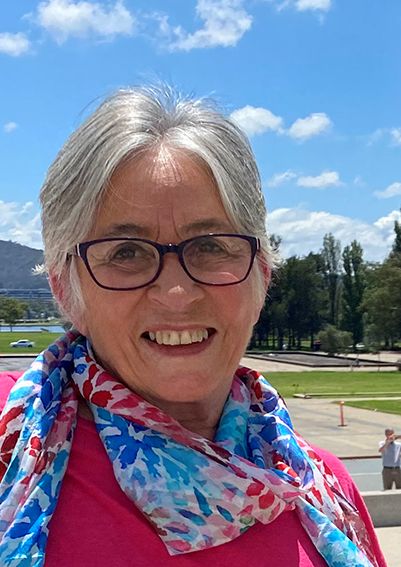 After teaching in secondary and tertiary institutions, Paula Durance worked in the field of international education in the Australian university sector, including research, curriculum, and international student programs. In 2022 she cleared the desk for stories, dusted off notebooks, and refocused on writing and voluntary community work in a small rural town in Central Victoria. Paula has degrees in Arts and Education, a Master of Education, and a PhD that explored the experiences of overseas students in the City of Melbourne.