Forgiveness
The trill of an overly cheerful nurse wakes me up to my oppressive reality: jangle, beeps and murmurs, the nauseating odor of institutional food, stale recycled air.
“We’re going home today, are we?” she chirps.
Condescending bitch. “Why? Are you coming with me?”
She ignores me, pulls out a large diaper.
I hiss at her. “No way. I don’t need a diaper.”
“Now, Reinhart. We don’t want any accidents, do we?” She takes advantage of my weakness, thrusts her hand between my legs and jerks the diaper into place. She jams a thermometer into my mouth and brusquely wraps a cuff around my wilted bicep to take my blood pressure. Before leaving she tucks the blanket around me and smooths it out while showing her official hospital smile. I am as helpless as a child.
I gum the insipid breakfast: watery porridge and toasted white bread, indistinguishable from each other except in texture. The toast sticks in my throat. I gag and struggle to dislodge it, coughing violently, my eyes bulging from my head until a projectile of dough shoots through my mouth. The ordeal leaves me stunned and exhausted.
“Hi Dad.” My daughter, Yvonne, wanders into my room looking as defeated as I feel. I’d rather I didn’t have to burden her, but I need her today. She attempts to smile; pale lips stretch over her teeth. I try to smile back, but my false teeth don’t fit in my shrunken jaw. I look like I’m 90, not 64. I imagine my smile is toothless, ghoulish; and like my mood: mirthless.
She’s followed by a couple of strapping young paramedics pushing a gurney. “You must be Reinhart.”
I nod.
“So, we’re going on a bit of a trip today, are we?”
There it is again: the baby talk. I want to snarl at them. I don’t. I’m dependent on them—they could orchestrate an “accidental slip.”
The robust youth lift me onto the gurney and wheel me through the suffocation of hospital corridors strung with doors opening into someone else’s misery—and out the emergency exit, where for a brief moment I sniff a whiff of crisp spring air before they slide me into an ambulance: a cold, grey stall reeking of disinfectant; and dangling straps, stethoscope, oxygen masks, and tubes.
Between morphine doses I feel the miles slipping by—a blur of muted color fleeing across the opaque glass window. Yvonne perches beside me on a stool. She’s a good kid, but an unripe apple. At thirty, she’s still underdeveloped. Her nature is to appease, being the middle child and the offspring of a mismatched couple. I wonder how my relationship with my wife influenced her. Another lash of the guilt whip. My life has been a series of fumblings, dreams unfulfilled, relationships gone awry, failures as father and husband. I have disappointed myself and all those who have depended on me.
I observe Yvonne: slouching, stress etched on her pinched mouth, furrowed brow and dark-circled eyes, and I feel compelled to lighten the atmosphere in this hurtling box. “Do you remember when we studied Transcendental Meditation in that guy’s basement?”
Her face lightens. “We took the course together. The night we were initiated and got our mantra, you lied.”
“I didn’t lie. You lied. When the guy asked if I had taken any drugs in the past week, I said yes, I’d smoked pot. What did you say?”
“Okay I lied. I said I hadn’t taken drugs so I could get a mantra. I didn’t think it was important.” She chuckles. “Driving home, you asked me what my mantra was. I said we weren’t supposed to tell anyone. You said if I told you mine, you’d tell me yours. I told you mine and you confessed you didn’t get yours. So, you lied too.”
We laugh at my long-ago deceit. A moment of levity before I silence the echo of shame reverberating in my conscience. I turn my heavy skull, sunken in the ambulance’s hard pillow, to look at my daughter.
“You know, Yvonne, I owe you an apology.”
She looks at me, incredulous. “Because of the mantra? No biggie. It’s a funny story.”
“Not that. Remember Mexico? You were 17 at the time.”
The crease between her eyes deepens, muscles around her mouth tighten. I can see the lines that will become permanent with age.
“I freaked out, remember?”
“Yeh?” Her voice is tight, guarded.
“Your mother and I ran from the other end of the beach scared to death we’d find you drowned.” I can’t forget the long-ago panic: rasping, clutching, straining. “And there you were, walking towards us as though nothing had happened. I could have collapsed with relief.” I remember the crash of adrenalin, relief, and confusion. “When you told me you’d been raped, I lost control. Blamed you. Said you invited the rapist by wearing the bikini.”
Yvonne is biting her fingernails; misery etched on her face.
I forge on. “I was wrong. I betrayed you. I regretted my words as soon as I said them. It’s gnawed at me ever since. I’ve wanted to tell you how sorry I was—so many times.” I watch her reaction.
She avoids my gaze, shifts on her stool. “That guy didn’t actually rape me. I fought him off.”
This is my daughter. Fragile, defensive, and self-deceiving. She evades my confession, doesn’t even try to absolve me of my guilt.
“But thanks for telling me that.”
I press her. “I’m saying sorry.”
“I forgive you, Dad.” Her voice snaps impatient—unforgiving. Her face contorts. “Just drop it, okay?” She looks away, closed to me.
What do I expect? I don’t deserve absolution. I shift my gaze toward the window. The flat dullness of an overcast day in early April, shades of browns and greys rattle by like an endless freight train lumbering through fuzzy abstracts of woodlands, wetlands and farmlands, reflecting my dejection.
Yvonne’s voice pulls me from imagined scenery and my meandering mind. “You know, Dad?”
Hope thumps in my chest. Does she want to forgive me? “Yes?” I reply.
“I’ve never worn a bikini since.”
Her words plunk on my shriveled shoulders like a toad on a lily pad: the weight of bygone anger, harm inflicted by my pride and intransigence. Some transgressions cannot be undone. I nod off, unsettled.
“We’re here, Dad.” Yvonne wakens me.
The ambulance doors click and scrape. The paramedics wheel me through a snippet of night; I gulp the brisk air greedily before I’m in another claustrophobic zone of disease. An eerie absence, a musty emptiness permeates the small village hospital. A couple of nurses shuffle about, shadows in the hallway.
At the reception desk, the charge nurse views our small entourage. “We’re not expecting anyone.” Her brittle tone bristles. “Who is he?” She flips through papers on a clipboard.
She expects the paramedics to answer. Instead, I do. “My name is Reinhart Wagner. And who might you be?” I try to flirt. My efforts land with a thud. The charge nurse grazes her eyes over me, dismisses me, and addresses the paramedics. “I have no information about this patient. And we have no room.”
The paramedic hands her a form. “We were instructed to bring him here. Reinhart Wagner. Here’s our dispatch record.”
She glances at it. “This is not a facility for a man in his condition. We don’t have the staff or the necessary equipment.”
The cold shrew. She would have turned Mary and Joseph away at the inn.
“Sorry, ma’am.” The paramedic stands legs apart, hands on hips. “We’re not taking him back. These are our instructions. He doesn’t need much. Not for long anyway.”
They talk about me as though I am a fleck of grime to flick off their shoulders.
The paramedic hands the nurse his papers. “Please sign here to acknowledge that we delivered him as per the request.” He thumps his meaty hand on my stretcher. “And we have to take the gurney back, so we’ll need to transfer him to one of your beds.”
The nurse sighs resigned, signs the form, and signals to another nurse to bring a bed, which promptly appears. The paramedics heave me onto it like a sack of potatoes. One of them claps my shoulder delivering a jolt of discomfort. “Goodbye, Reinhart. Good luck.” They leave the building.
Yvonne hovers.
“You can go now,” I say. “I’ll see you tomorrow.”
“Are you sure?” Relief is written on her face.
“Yes. Go.”
She scurries away, released from the sour breath of illness.
The charge nurse scowls. I appear to be the only patient in the place, so she should be pleased to have me. Isn’t nursing a spiritual calling? And if she doesn’t subscribe to that vocation—this is her job for which she is handsomely paid.
A nurse fetches me and wheels me into a room with a large window. “Welcome to the Two Hills Hospital, Reinhart. This is our premier suite.” She giggles.
“Thank you,” I’m grateful for her kindness and levity. “And since we’ll be seeing more of each other, tell me your name.”
“Irene,” she says. “Sorry about Nurse Ratched in Admitting.” Irene rolls her eyes. “She’s not always like that. We just got news about more budget cuts. Don’t worry. We’ll take good care of you.”
“Thank you.” I relax in Irene’s compassion. “I’m in some pain, Irene. Can you help me?”
“Of course. I can give you a shot of morphine. You okay with that?”
“Oh yes.” Irene fills a needle while I salivate like Pavlov’s dog.
“You’re like a pin cushion. I’m sorry to have to jab you again, but it will be worth it, I promise.” She searches my arms for a vein that hasn’t collapsed or skin that hasn’t been bruised, finds a spot and slides the needle into my bloodstream.
“Thank you, Irene. You did that very gently.”
Irene’s smile is beatific. And her gaze—I try to articulate its warmth, but words elude me as I melt into a luscious drift.
Irene’s is the first face I see in the morning, consoling me with another injection.
I stare out my window watching the spring unfold: a mauve crocus blossoming into its brief life; a vee of Canadian geese spread out in the blustery sky, arriving after struggling for thousands of miles to get here; a hapless worm plucked from the thawed earth, dangling from a robin’s beak.
Madeleine bursts in, transforming the featureless sickroom. The wildness of the outdoors clings to her wholesomeness, sunlight flashes in her eyes. She takes off her woollen coat, the same sensible burgundy one she’s worn for two decades, now moulded to her shape.
“It’s not as warm as it looks out there.” She rubs her hands together as she walks toward me. Unadulterated pleasure electrifies me. Like an infant I lie eager, anticipating her touch. After my wretched journey I’m here with Madeleine: my destination.
“Ach Reinhart.” Eyes awe-filled, Madeleine gazes on me, her husband—once virile and handsome, now skeletal and decayed. She strokes my cheek. “I’m glad you’re home.”
Her hand is cool and soothing, fresh air blooms in her breath, she smells of Nivea cream and fresh bread.
Why did I leave her? I struggle to remember the bitter days of November. When I left home to die incognito.
“I brought you your favorite meal: red cabbage and sausages, the way you like them: a bit of butter in the cabbage and the sausages broiled, not fried. With mashed potatoes. And the chocolate milk you like—not the homemade-with-powdered-milk kind. It’s store bought.” She adjusts the bed so I am sitting, unfolds the metal table across my lap, and lays a full plate in front of me, its savory scent an infusion of delight. She pours a glassful of chocolate milk and sets it on the table.
This is my wife, Madeleine, welcoming her prodigal husband home. My wife whom I have resented and belittled, who I believed oppressed me; the woman who has always been a stalwart and faithful companion. The woman I ran away from—angry, spiteful, leaving her to fend for herself on our failing farm, her not knowing where I went or if I’d be back.
Truthfully, I didn’t want to come back—I wanted to die alone. I didn’t want to be a burden, and I didn’t want to lose my dignity. My body wouldn’t allow me that grace. Now, I’m thankful for the defeat. Every fiber in my body aches with humility, gratified to be united with Madeleine for as long as I am allowed.
“Thank you, Madeleine.” My senses swim in the pleasure of the sweet red cabbage melting in my mouth. I cut into a piece of sausage, watch the juices seep from it. I taste its salty richness. I gulp the sublime creaminess of the chocolate milk.
I spiral into the jumble of my life: when I wore knickers and lace-up boots and ate this same meal at my mother’s table, ricocheting into the decades with Madeleine in kitchens with Formica tables; the teak dining room table I proudly brought home after I sold my first house—a large oval that accommodated our big family through so many meals, the jokes, the games, the Christmases, the conversations. The honey glow of its wood—nicked and chipped over the years.
I burp. “This is the best meal I’ve ever eaten.” My bowels will surely revolt—later.
“That makes me happy, Reinhart.”
“The last supper,” I joke. Not funny. I realize this may indeed be my last meal.
“Shhhh—I’m here to make you better,” Madeleine murmurs.
She won’t. The doctor has diagnosed the hopelessness of my situation. Palliative. She knows that.
Madeleine leans over to release my hospital table. Like an infrared lamp, the warmth of her bosom beams through my flesh. I am left flush with her lingering warmth. I take her hand in mine, feeling the tender texture of her skin.
“Madeleine, I’ve been thinking—I don’t understand how such a capable, beautiful, and intelligent woman like you would stick with the exceptionally bad husband I have been. For decades.” I search her eyes. “Why did you stay?”
Madeleine regards me quizzically, tips her head slightly to the right. “We had seven children, Reinhart. Remember? I couldn’t leave.”
“So, it wasn’t my charm?” We laugh heartily. Perhaps Madeleine laughs a bit too heartily. “You find my suggestion absurd, Madeleine. I’m hurt.” More howls of laughter. My emotions wobble. I wrestle the uninvited, silly tears that seek to seep from my soggy eyes.
My abject expression interrupts our jovial mood. The laughter stops.
“We’re just making fun, Reinhart. I’ve never known you to be so sensitive.” She leans over, kisses my hollow cheek. “I never expected a perfect husband.” Her voice soothes my sagging spirit. “You gave me so much more than I could have imagined. You always made up for anything you made me endure. I have always loved you, Reinhart.”
Her mercy shatters my misery, scatters my self-loathing, soothes my tangled, tortured mind. I squeeze Madeleine’s hand with the last whisper of my strength.
• • •
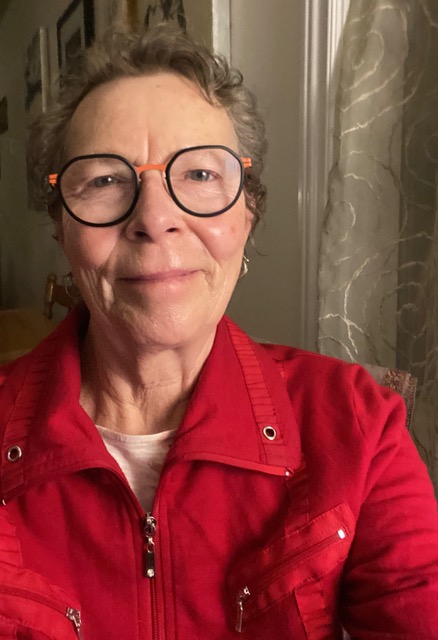 Anne Georg lives in Calgary, Canada. Her journalism has appeared in various media. Anne self-published a graphic non-fiction with illustrator Jaye Hilchey. Anne’s fiction has been published in Friday Flash Fiction, Flash Fiction Magazine, confetti, Consequence Forum, CafeLit, and Spadina Literary Review. Anne volunteers as a judge for the Alberta Magazine Awards. She finds her literary community with the Alexandra Writers Centre Society and the Writers’ Guild of Alberta.