Just Imagine
You are old. Your face has fallen and folded in strange ways, and the eyes staring at you in the mirror look small and apprehensive. You’ve come awake in a sunlit room surrounded by your most personal belongings, carefully selected by those who know you best—your son and daughter. The items are calculated to bring comfort, diversion, a sense of familiarity. Yet . . . .
There’s your father in a black-and-white studio photograph, young and vital, airbrush-handsome in his suit and tie, dark, slicked-back hair. There’s the handwoven basket you bought years ago from an artist on the Lummi reservation, the old typewriter you once used but are unsure how to approach now, the warm-hued maple dresser whose drawers you’ve opened every day for decades to find your socks and shirts. Your old sewing basket has the threads and needles you need to make repairs, and for several months you’ve kept it near. It’s like a box of purpose. All these things seem to have come with you through a voyage.
There are books on shelves that you know you’ve read. Sometimes you complain to your daughter that you’ve read them all, so what’s the point of looking? However, you discover a new one every couple of weeks, a treasure you say must have been put there by someone who wandered in and left it, as if they returned it to the wrong library.
Sometimes in your set of rooms, you feel almost safe—quiet afternoons when you fall asleep to the distant sound of construction in the streets beyond, or mid-morning after a sit on the big porch out front. Other times, most times, you don’t understand how you came to be in this place. And that can get you walking, round and round through the carpeted halls, or out along the cement path that leads halfway around the building before reaching a high, locked, white gate.
You can’t leave. Not on your own, anyway, which is the whole point. They, the women who run the place, got all excited the time you made it downhill to the first street corner, where they found you standing under the STOP sign. They insist you walk with an aide, or worse, a group. Where and when, exactly, did your self-sufficiency slip away? I want my life back! you told them that day.
It wouldn’t be entirely accurate to call you a loner. You just don’t care to know everyone’s intimate details, and you certainly aren’t interested in raking up your own. People are always homing in on details. The more they learn about you, the more they try and insinuate themselves into your life, ask questions as if they’d ever understand, ask questions as if you have answers at hand. The closer they get, the more likely they are to start making demands, like expecting you to join some group activity or sit by them in the dining room or listen to their physical complaints. You can be pleasant with these people over coffee and toast, but that’s the extent of it. Despite your unreliable memory, you’ve memorized the route from the dining room to your room that best avoids running into anyone.
You want intellectual stimulation, though you can’t articulate it. Looking through a book with pictures by Monet or Chagall, or photographs of Japanese gardens, can feed you for a week. You can go over and over an image in your mind, the beauty of a painting, the tranquil grace of a garden. You can tell your daughter or son if they visit soon enough. You can find yourself again, in dribs and drabs.
You seldom find the right conversation. Young people, your children, talk for hours without listening, rapid-fire jabbering. The women where you live seem to talk in riddles. You may be starting to speak this way yourself, so lately you say less.
Your daughter visits. She is bright and lively, and it’s wonderful to see her, especially those first few minutes when she suddenly appears at your door, familiar and safe, a sudden off-ramp into the life before. It’s a relief to find someone you can complain to about lunch, your knee, strange dreams. But she can be depressing, too, with all that determination. You have to be careful or she’ll want to drag you out to talk to one of the ladies who runs the place, start making arrangements for this or that pedicure, haircut, electrical socket that needs replacing. She always wants to go somewhere, and sometimes you wish she wasn’t there or that she just lived there. That would be the best. If she were always there, you would never have to worry about where she was living or where you were living or what on earth was happening, and why.
Most of the time it’s lovely, once the middle of her visit is upon you. You like it when she has the time to drive you to the countryside or sit on a park bench and gaze at the lake. Other times, you just don’t have it in you to be bright and cheerful, which your daughter seems to expect. She tries to engage you in memories that go beyond what or who you know, describes scenes apparently in your past that are foreign as Egypt. And yet, dreamlike, these scenes are full of names and flashes of images that seem familiar through the repeating. Near the end of a visit, it’s all like a dream: the day’s activities, your aged self, the various landscapes and interactions you’ve experienced with the middle-aged version of the little girl you used to have, who’s disturbingly like an extension of yourself.
You arrive at a building atop a great hill. It has been made to look like a New England bed-and-breakfast, with gables and a huge, white-fenced porch. Do I live here? you ask. A current of apprehension runs through you, as you begin to sense that you do live here, but that it is fundamentally a foreign place. Your daughter escorts you upstairs. She sees that you are oriented to your cozy, neat room with its familiar furniture and books and black-and-white faces peering out from across the decades: Dad in the 1930s, Mother and your brothers and grandmother swimming in a Minnesota lake in the 1920s, your husband in the 1950s. But you’re not sure where you are in the scope of things. You might confuse your son with your long-gone brother, or a picture of yourself with your mother.
You must trust your daughter’s version of everything you’ve done and seen and felt. You can’t remember the house you lived in for over fifty years, the house where your children grew up and your husband corrected student papers. You forget that you were married for forty years and had children.
Every lake you see is in Minnesota, despite the fact that you haven’t lived there in seventy years. As you drive through the countryside with your daughter, in the middle of one of her visits, you have the window rolled down and you talk about White Bear Lake, and Moish and Ess, and their son, Squish. You’ve returned to the Minnesota countryside where your father’s best friend lived with his beautiful Swedish wife, Ess. These people are vivid in your mind. Everything from when you were fourteen is vivid for a moment. Your daughter asks you questions about Moish and Squish, summers at the lake. As you remember it, your daughter was there, too. She must have grown up with you and played with the same kids. Surely she remembers the Henriksens across the street, and playing in Minnehaha Creek after dinner? Your daughter tells you she grew up in Seattle, but that seems incorrect. You see your old house so vividly, Mother in her apron, the cellar full of jarred fruit she and Dad canned in the summer heat. Mother never went on walks for pleasure, no matter how hard you tried to persuade her.
When you feel lost inside your two-room apartment, with its cramped floor plan and high wall beyond the windows, its cast of caregivers from African countries looking in on you every few hours, you find your sewing basket and look for something to mend, or find a garden book to take you away. Or you fall asleep in that light room with its maple dresser and tiny, framed picture of your daughter, in color, smiling at you.
• • •
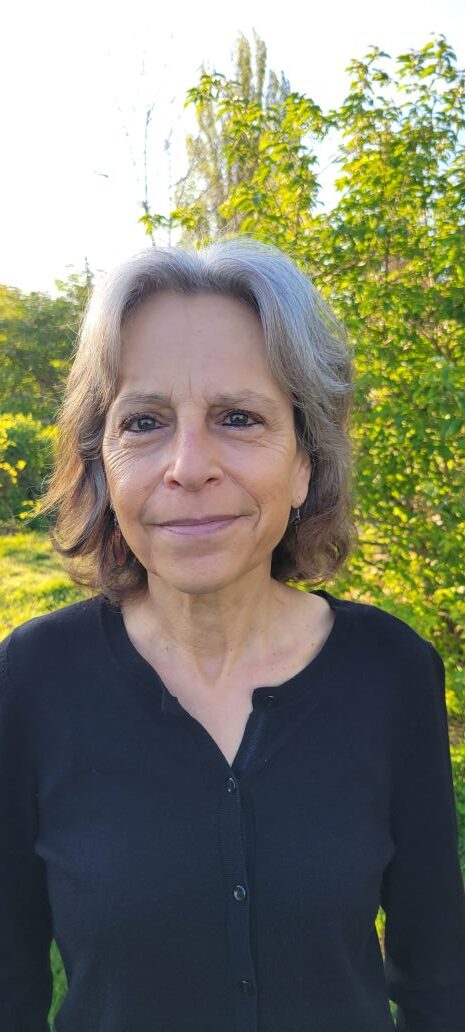 Julian Bentley-Edelman lives in Bellingham, Washington. She holds an MFA in Fiction Writing and an MSW from the University of Washington, and has worked as a classroom teacher and elder-care social worker. When she isn’t writing, she runs long distances or hikes in the Cascades with her husband. Her work has appeared in Smoky Blue Literary and Arts Magazine, and is forthcoming in Persimmon Tree and the 2026 Fish Anthology.